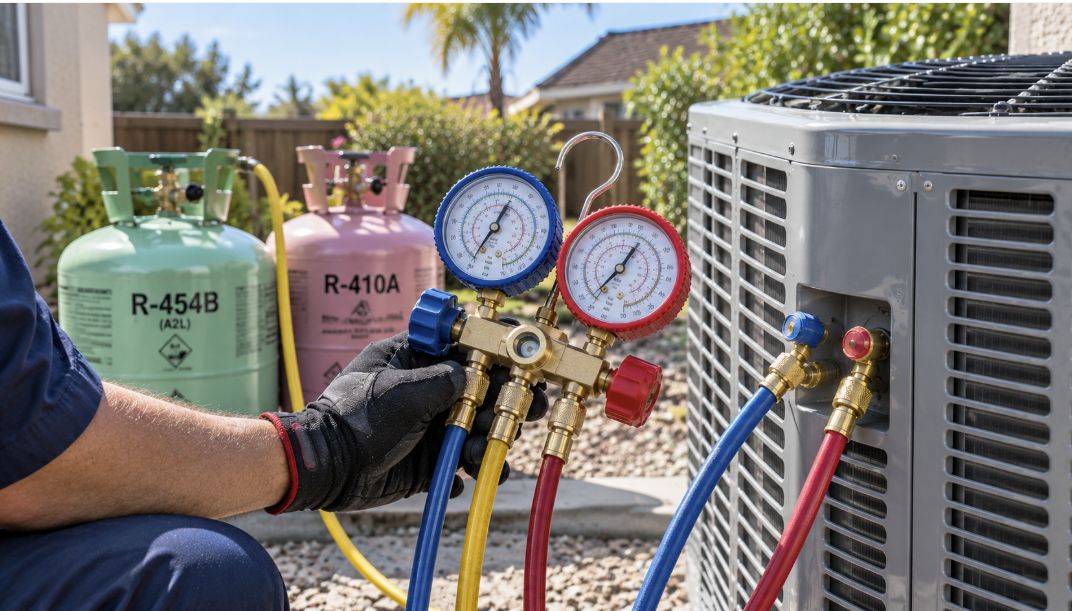




Your AC uses R-410A, and every new system on the market now uses R-454B. Here’s what actually changed, whether your current system is affected, and what it means for California homeowners specifically.
R-454B is the refrigerant that has replaced R-410A in virtually all new residential AC and heat pump systems sold in the U.S. as of 2025-2026. It’s a federal requirement, not a marketing choice — R-410A’s global warming potential is too high to meet new EPA rules for newly manufactured equipment. Your existing R-410A system isn’t illegal and doesn’t need to be replaced early. But if you’re buying a new system today, it will run on R-454B (or a similar low-GWP refrigerant) — there’s no way around it, regardless of brand.
Why This Change Happened
This isn’t a case of an HVAC manufacturer chasing a trend. The AIM Act, passed in late 2020, tasked the EPA with phasing down high-GWP refrigerants nationwide. In October 2023, the EPA finalized a rule setting a hard GWP ceiling of 700 for new residential AC and heat pump equipment. R-410A has a GWP of 2,088 — nearly three times over the limit — so it simply couldn’t continue being used in newly built systems.
Jan 1, 2025
Manufacturers stop building new R-410A equipment
Jan 1, 2026
New installations move to low-GWP refrigerants
No deadline
Servicing existing R-410A systems remains legal indefinitely
R-454B has emerged as the dominant replacement for ducted systems industry-wide, including for major brands like Bryant and Carrier, where it’s sold under the name Opteon™ XL41.
R-454B vs. R-410A: The Actual Differences
| R-410A | R-454B | |
|---|---|---|
| Global Warming Potential (GWP) | 2,088 | 466 (about 78% lower) |
| Safety classification | A1 (non-flammable) | A2L (mildly flammable) |
| Composition | Blend of R-32 and R-125 | ~68.9% R-32, ~31.1% R-1234yf |
| Operating pressure | Baseline | Similar, slightly different — not interchangeable equipment |
| Cooling performance | Industry standard for two decades | Comparable; new equipment is often more efficient overall due to current SEER2 design standards |
The “A2L” label is the detail that raises the most questions, so it’s worth explaining directly: it means the refrigerant is mildly flammable — a low burning velocity that requires specific concentration and ignition conditions to combust. It’s a meaningfully different risk category than a genuinely flammable gas, and modern A2L-rated equipment is engineered with leak detection and ventilation requirements specifically to keep that risk low. It’s not something that should make you nervous about a properly installed, code-compliant system.
Is My R-410A System Now Illegal?
This is the single most common misunderstanding about this transition. Nobody is coming to remove a working AC from your home, and there’s no deadline forcing you to replace it early. What changed is the manufacturing and installation standard for new equipment, not the legality of equipment already in service. There’s also no end date currently set on servicing existing R-410A systems — the refrigerant remains available, just gradually more expensive as production winds down.
Can I Just Add R-454B to My Existing System?
No. R-454B is not a drop-in retrofit for R-410A equipment. The two refrigerants have different pressure and material compatibility characteristics, and R-410A systems weren’t engineered or safety-rated for a mildly flammable refrigerant. If your system needs refrigerant, a licensed technician will recharge it with R-410A (assuming supply is available) — switching refrigerants requires new, purpose-built equipment, not a different can of gas in the same unit.
What This Means for California and San Diego Homeowners
California didn’t wait for the federal deadline — the state adopted A2L refrigerant provisions into the California Mechanical Code and California Fire Code back in mid-2024, ahead of most of the country. As of January 1, 2026, HVAC permits in San Diego fall under three overlapping codes:
All three include specific requirements for A2L systems — things like refrigerant leak detection and ventilation requirements for certain equipment configurations. In practical terms, this means two things for San Diego homeowners:
- Your installer needs to be current on A2L-specific training and code requirements — this isn’t optional paperwork, it affects how the system is designed, ventilated, and permitted.
- Any technician working on refrigerant of any kind needs EPA Section 608 certification, and for A2L equipment specifically, additional training beyond that baseline requirement.
This is one of those details that’s easy for a homeowner to miss entirely until something goes wrong with an improperly permitted or installed system. Worth confirming directly with any contractor quoting a new install.
How This Affects a Repair-vs-Replace Decision
If your R-410A system needs a refrigerant recharge, factor in that R-410A pricing has been rising as production winds down, and that trend is expected to continue. For an aging system already on the edge of a repair-vs-replace decision, a climbing refrigerant cost can tip the math toward replacement sooner than it might have a few years ago. If you’re weighing that decision right now, our breakdown of the $5,000 rule for HVAC walks through a straightforward way to think about it, and our AI-powered HVAC diagnostics can give you a real, data-backed answer specific to your system rather than a general rule of thumb.
If you do decide to replace, every new system we install — Bryant, Mitsubishi, or otherwise — comes with the correct refrigerant already built in, permitted and installed to current California code. You’re not making a refrigerant decision as a homeowner; the equipment you choose determines it for you.
Frequently Asked Questions
Do I need to replace my R-410A system right now?
No. There’s no deadline requiring you to replace a working R-410A system. It remains fully legal to operate, service, and recharge.
Is R-454B dangerous because it’s flammable?
“Mildly flammable” (A2L) is a specific, low-risk classification, not the same as a genuinely combustible gas. Properly installed, code-compliant A2L equipment is designed with safety margins specifically around this classification.
Will R-410A become impossible to find?
Not impossible, but increasingly expensive. Production is winding down under the EPA’s phasedown schedule, and reclaimed/recycled supply is helping bridge the gap, but prices are trending upward over time.
Does this affect ductless mini-split systems too?
Yes — the same GWP threshold applies to mini-splits, which is why current-generation ductless systems from every major manufacturer have also moved to low-GWP refrigerants.
Do I need a special contractor for A2L refrigerant systems in San Diego?
You need a licensed contractor who’s current on A2L training and California’s specific code requirements — not every shop has kept pace with this transition, so it’s worth asking directly before you sign a quote.
Not sure what refrigerant your system runs on, or whether it’s time to consider replacement? Get a straight answer from Omega Air — we’re current on California’s A2L requirements and can tell you exactly where your system stands.
Did you like this article and find it helpful? Share the link with your friends!
- Published on